Why Most Study Techniques Fail
There is a gap between the study strategies most students use and the strategies that neuroscience has shown to be effective. This gap is not the students' fault — it exists because the techniques that feel productive are often the least effective, while the techniques that produce real learning feel harder and less satisfying in the moment.
Re-reading your notes feels like progress. Highlighting feels systematic. Reviewing material in long blocks feels thorough. But decades of cognitive psychology research tell a different story. A landmark 2013 review in Psychological Science in the Public Interest by Dunlosky and colleagues evaluated ten major study strategies and found that the most popular — re-reading, highlighting, summarising, and keyword mnemonics — had low utility. The two strategies with the highest utility — practice testing (active recall) and distributed practice (spaced repetition) — are the ones students use least.
The reason comes down to a phenomenon called the fluency illusion. When you re-read familiar material, it feels easy because you recognise it. Your brain interprets recognition as knowledge. But recognition and recall are neurologically distinct processes. Recognition simply requires matching incoming information to an existing trace. Recall requires reconstructing the trace from internal cues — which is the skill you actually need in an exam room.
Understanding why your brain forgets — and how to counteract it — is the single most valuable thing you can learn about studying.
Is a Foggy Brain Holding You Back?
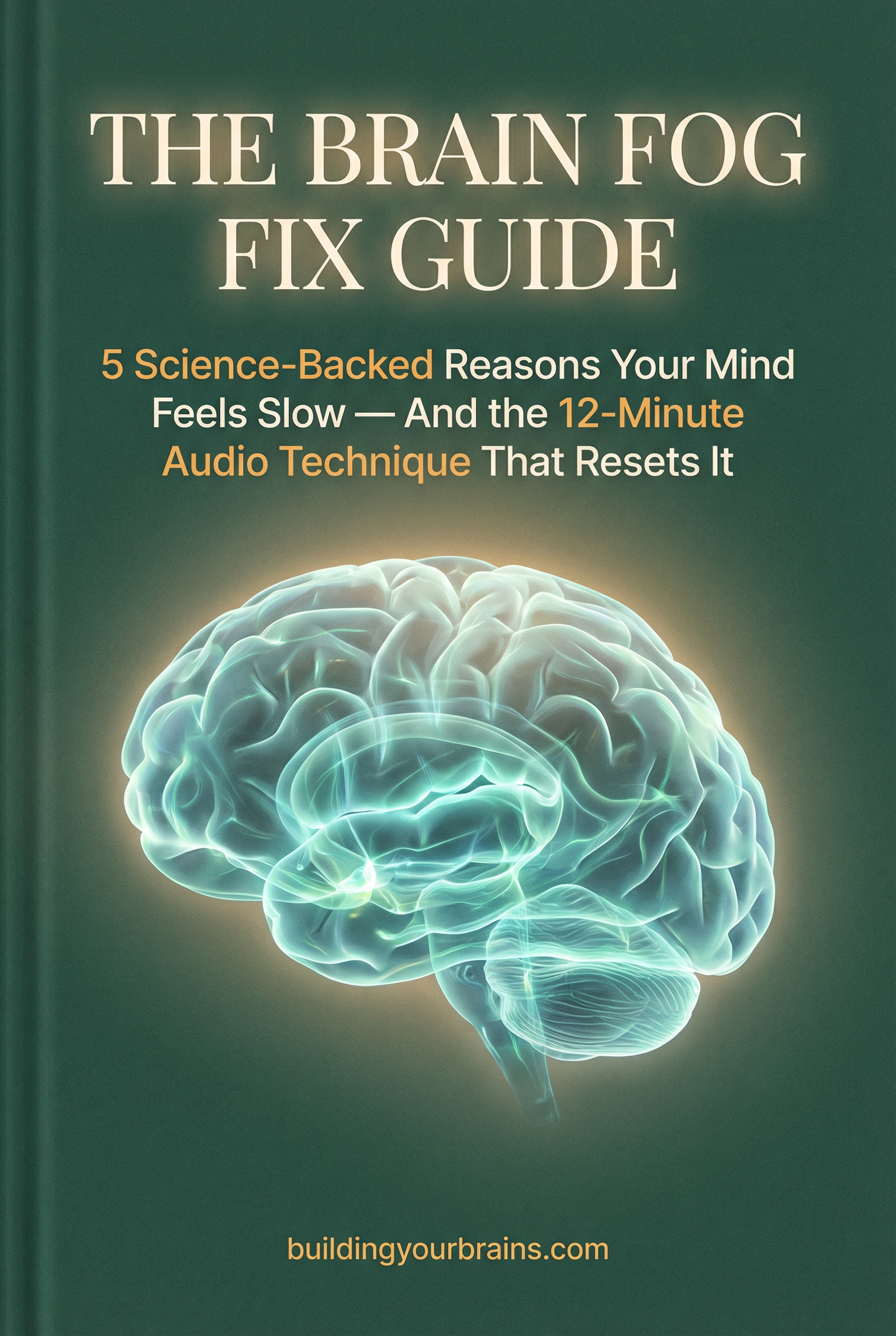
Download the free Brain Fog Fix Guide and discover the 12-minute audio technique that thousands use to restore mental clarity — no supplements, no meditation required.
Get the Free Guide →How Memory Actually Works
Memory is not a recording. It is a reconstruction. Every time you recall something, your brain is actively rebuilding the memory from stored fragments, filling in gaps with plausible detail, and then re-consolidating what it just reconstructed. This makes memory both flexible and fragile.
The Stages of Memory Formation
New information enters through sensory processing and holds briefly in working memory — the brain's mental scratchpad. Working memory is severely limited: most adults can hold only 4–7 items simultaneously. If information is not processed more deeply within seconds, it disappears.
For information to move from working memory into long-term storage, it must be encoded — connected to existing knowledge, repeated, emotionally tagged, or processed during sleep. This encoding process depends critically on the hippocampus, a seahorse-shaped structure in the medial temporal lobe that acts as the brain's indexing system for episodic and declarative memory.
The hippocampus is also one of the brain structures most sensitive to stress hormones. When cortisol is elevated — as it often is during exam periods — hippocampal encoding efficiency drops measurably. You can read the same page three times under high stress and retain almost nothing. This is not a willpower problem. It is a neurochemistry problem.
The Forgetting Curve and Why It Matters
In the 1880s, German psychologist Hermann Ebbinghaus mapped the rate at which memory fades without reinforcement. He found that humans forget approximately 50% of new information within one hour, 70% within 24 hours, and up to 90% within a week. This "forgetting curve" has been replicated consistently in modern research.
The shape of the curve has critical implications for how you schedule study time. A single long session of three hours produces far less retention than three one-hour sessions spaced across several days, even though the total time is identical. This is because spacing forces repeated retrieval, and retrieval itself is the mechanism that strengthens the memory trace.
For a deeper understanding of how memory consolidation works at the cellular level, see our comprehensive guide on how to improve memory — particularly the section on synaptic potentiation and BDNF's role in making new memories stick.
Encoding Specificity and Context
Memory is contextual. Information encoded in one state is most easily retrieved in the same state — a principle called encoding specificity. This has practical implications: studying in a stressed, anxious state creates memories that are easier to access when stressed and anxious. Studying in a calm, focused state creates memories that are more accessible when calm and focused.
Since exams typically involve at least moderate anxiety, you want to practise retrieval in that mode. But you also want to encode in conditions that support deep hippocampal processing. Getting your brain into the right physiological state before studying is not a luxury — it is a core part of effective encoding.
Spaced Repetition: The Most Powerful Study Method You're Probably Not Using
Spaced repetition is a learning method in which you review material at increasing intervals, timed to catch information just before you would forget it. The intervals grow longer after each successful recall: you might review a new card after 1 day, then 3 days, then 1 week, then 2 weeks, then 1 month. Each successful retrieval at the edge of forgetting strengthens the memory trace more than a review when the material is still fresh.
This is not a new idea — it is one of the most replicated findings in cognitive psychology, supported by over a century of research from Ebbinghaus through to contemporary neuroscientists at the Salk Institute. What is relatively new is software that automates the interval scheduling. Tools like Anki, SuperMemo, and RemNote calculate optimal review timing algorithmically, meaning you never have to guess when to study what.
How to Implement Spaced Repetition
The principles are straightforward. Create flashcards for individual facts, concepts, or processes — not summaries. When reviewing, try to recall the answer before flipping. Rate your confidence honestly: cards you struggled with get scheduled sooner; cards you answered easily get pushed further into the future. Keep sessions short and consistent — 20 minutes daily beats four hours on a Sunday.
The critical insight is that spaced repetition works because it exploits the way the brain consolidates memory. Each time you retrieve a memory, you reactivate the neural pathway associated with it. Over time, this pathway becomes physically more efficient — the synaptic connection between neurons strengthens through a process called long-term potentiation (LTP). The spacing between retrievals matters because memories need time to be re-consolidated and stabilised before the next retrieval.
To understand how brainwave states interact with spaced repetition for even better results, read our dedicated article: Spaced Repetition and Brainwaves: Why Anki Works Better in Theta.
Active Recall: The Companion to Spaced Repetition
Spaced repetition tells you when to study. Active recall tells you how. Instead of reading a passage and thinking "yes, I understand this," active recall requires you to close the book and answer the question: "What did I just learn?" This forced retrieval — even when it feels difficult and uncomfortable — is the cognitive work that creates durable memory.
Research by Jeffrey Karpicke at Purdue University found that students who used retrieval practice retained 50% more material on a one-week delayed test than students who re-studied the same material for the same amount of time. The act of attempting retrieval, even when the answer is partially wrong, primes the brain to encode the correct information more strongly when it is subsequently provided.
Brainwave States and Learning
Your brain generates electrical patterns — brainwaves — that shift depending on what you are doing and how you feel. These frequencies have measurable effects on cognitive performance, including learning and memory.
The Five Brainwave States
At the high end, gamma waves (30–100 Hz) appear during intense mental processing and moments of insight. Beta waves (13–30 Hz) characterise alert, active thinking — but also anxiety and stress. Alpha waves (8–12 Hz) emerge in relaxed, calm focus — the state you reach after meditating or closing your eyes. Theta waves (4–8 Hz) occur during deep relaxation, light sleep, and the hypnagogic state just before sleep onset. Delta waves (0.5–4 Hz) dominate deep sleep.
For students, the two most relevant states are alpha and theta. Alpha represents a relaxed readiness that is ideal for absorbing and reviewing information. Theta is associated with the hippocampal activity involved in encoding new memories into long-term storage.
A seminal review published in Trends in Cognitive Sciences found that theta oscillations in the hippocampus synchronise with neocortical activity during memory encoding — essentially coordinating the "conversation" between the hippocampus (which tags new experiences) and the cortex (which stores them long-term). Higher theta power during encoding is associated with better subsequent recall.
Why Most Students Study in the Wrong Brain State
The problem is that most students sit down to study while in a high-beta stress state — anxious about deadlines, distracted by notifications, running on caffeine and cortisol. High-beta activity is actively antagonistic to the alpha and theta states that support deep encoding. You can physically sit at your desk for four hours in a high-beta state and form very few strong memories.
This is why a brief brain state reset before studying can produce disproportionate returns. Even a 10–15 minute shift from stressed beta toward calm alpha or theta — whether through breathing exercises, a brief meditation, or purpose-built audio entrainment — primes the hippocampus for better encoding throughout the subsequent session.
For a complete breakdown of how different brainwave states serve different phases of the study process, see: The Best Brainwave State for Learning and Memory Consolidation.
For the broader science of all five brainwave types and how they interact with cognitive performance, our comprehensive resource Brainwaves Explained: Alpha, Beta, Theta, Delta, Gamma covers the full picture as the conversion hub for brainwave science on this site.
Audio Entrainment as a Study Aid
Brainwave entrainment through binaural beats — an auditory phenomenon where slightly different frequencies played in each ear cause the brain to generate a third "beat" frequency — is one of the more accessible ways to influence brainwave state. When the beat frequency falls in the theta range (4–8 Hz), EEG studies confirm measurable increases in theta power within 10–20 minutes of listening.
For students, a 12-minute theta entrainment session before studying can shift the brain from a stressed, high-beta state into the alpha-to-theta transition zone associated with receptive learning. It is not a replacement for the cognitive work of studying — but it can meaningfully improve the quality of encoding during the session that follows.
The Genius Song
A professionally engineered 12-minute theta brainwave audio program. Use it before your study session to prime your brain for deeper encoding and better retention. $39 one-time · Lifetime access · 90-day money-back guarantee via ClickBank.
Try The Genius Song Risk-Free →Affiliate disclosure: This is an affiliate link. I may earn a commission at no extra cost to you.
Test Anxiety and the Brain
Test anxiety is not a character flaw or a sign of inadequate preparation. It is a specific neurological event with predictable biochemistry. Understanding it changes how you respond to it.
What Cortisol Does to Your Exam Performance
When you perceive a high-stakes situation — like walking into an exam — your hypothalamus triggers a stress cascade that raises cortisol and adrenaline. In short bursts, this sharpens alertness. But when sustained, high cortisol directly impairs the prefrontal cortex — the brain region responsible for working memory, complex reasoning, and the cognitive flexibility you need for exam questions.
This is why students who know their material well sometimes "blank" in exams. The information is there, but cortisol-driven prefrontal impairment is temporarily blocking access to it. The knowledge is encoded; the retrieval pathway is chemically obstructed.
A practical pre-exam protocol that lowers cortisol — even partially — can meaningfully restore prefrontal function. Deep breathing, brief meditation, or a short theta audio session in the 15 minutes before an exam has been shown in multiple studies to reduce cortisol markers and improve performance on subsequent cognitive tasks.
For a complete guide to managing test anxiety using the neuroscience above, see: Test Anxiety: What's Happening in Your Brain and How to Stop It.
Your Study Environment
The external environment shapes your internal cognitive state more than most students realise. Several environmental factors have strong evidence behind them.
Music and Studying
Music with lyrics consistently interferes with language-based learning — reading, writing, and verbal processing. The phonological loop in working memory processes both the words in the music and the words you are trying to learn, creating genuine interference. Classical instrumental music has been more mixed in research, showing benefits in some studies and no effect in others.
The most consistently beneficial audio for studying is not music in the traditional sense, but frequency-specific binaural beats in the alpha and theta range. These do not carry melodic information that competes with your working memory; instead, they gently shift your brain's electrical state toward the frequencies associated with receptive learning.
For a detailed breakdown of the evidence comparing different types of study audio, see: Study Music That Actually Works (It's Not Lo-Fi Beats).
Light, Temperature, and Physical Setup
Natural or cool-white light (around 5,000–6,500K colour temperature) supports alertness and reduces eye strain. Warm or dim lighting shifts the brain toward relaxation, which may be appropriate for review sessions but not for active problem-solving. Temperature between 20–22°C (68–72°F) is associated with optimal cognitive performance in multiple studies.
Perhaps most importantly: eliminate sources of dopamine competition. Notifications, social media, and the mere presence of a smartphone reduce available cognitive resources even when the device is not being used — a phenomenon called "brain drain" documented in research from the University of Texas at Austin.
The Case for Physical Study Breaks
A 2014 study in Cognition found that brief mental "deactivation" — even a 50-second look at a natural scene — restored directed attention capacity. More broadly, evidence for the ultradian performance rhythm suggests that sustained cognitive work produces diminishing returns after 90 minutes, with performance recovering fully only after a genuine non-cognitive break.
This does not mean checking your phone. It means walking around the block, lying on the floor and breathing slowly, or spending 12 minutes with a theta audio session — anything that genuinely lets the prefrontal cortex recover before the next focused block.
Sleep Is Not Optional
The relationship between sleep and academic performance is one of the most robust findings in educational neuroscience. Sleep is not rest time that competes with study time. Sleep is when studying gets finished.
Memory Consolidation During Sleep
During slow-wave (non-REM) sleep, the hippocampus replays the day's experiences in compressed form, transferring episodic memories to cortical long-term storage. During REM sleep, the brain integrates new information with existing knowledge, identifies patterns, and builds associative connections that support insight and problem-solving.
This means that six hours of sleep after studying is not a good substitute for eight hours. You are literally cutting short the consolidation process that converts what you studied into lasting knowledge. Research by Matthew Walker at UC Berkeley has shown that pulling an all-nighter before an exam does not help even if you learned the material — the sleep deprivation impairs hippocampal function enough to reduce test performance by 40% compared to well-rested control groups.
A practical rule: whatever you study in the last session before sleep gets the full consolidation treatment. Use that window deliberately. Review the most important material in the 30–60 minutes before bed, then protect your sleep as a non-negotiable part of your study protocol.
Naps and Learning
A 60–90 minute nap in the afternoon contains a full cycle of slow-wave sleep and some REM, providing a genuine mini-consolidation window. A 2010 study by Sara Mednick at UC San Diego found that students who napped between two learning sessions retained as much as those who had a full night of sleep, while those who skipped the nap showed the expected decline. Even a 20-minute power nap restores working memory capacity by clearing hippocampal "buffers" that fill up during sustained learning.
Your Complete Study Protocol
Combining everything above into a practical system:
Step 1: Prepare Your Brain State
Before sitting down to study, spend 10–15 minutes in a deliberate downshift. This can be diaphragmatic breathing, a brief meditation, or a theta-frequency audio session. The goal is to move from whatever stress state you are carrying into a calm, receptive alpha or theta state. This single step can improve your encoding efficiency for the entire subsequent session.
Step 2: Work in 90-Minute Focus Blocks
Set a timer for 90 minutes. During that time, remove all notifications and distractions. Use active recall methods rather than passive review. Engage with the material: explain it in your own words, draw diagrams, or test yourself with flashcards.
Step 3: Take a Genuine Recovery Break
After 90 minutes, take a 20-minute break that does not involve screens. Walk, stretch, lie down, or do another theta session. Do not use this time for social media — that keeps the prefrontal cortex activated and prevents the recovery you need. For more strategies to maintain focus across long study sessions without burning out, read: How to Focus for Long Study Sessions Without Burning Out.
Step 4: Use Spaced Repetition for Review
After each study session, convert your most important material into flashcards in your spaced repetition system. Review your due cards daily — 20 minutes of spaced repetition review is worth more than an additional hour of re-reading. If you are dealing with a large volume of material, prioritise by exam weight and urgency.
Step 5: Protect Your Sleep
Treat sleep as the final phase of studying, not as its enemy. Avoid studying beyond midnight before an exam. Keep a consistent sleep schedule throughout the semester, not just in exam periods. If you must choose between one more hour of cramming and one more hour of sleep, sleep is almost always the better choice for exam performance.
Step 6: Use a Pre-Exam Protocol
On exam day, your goal is not to learn new material but to reduce cortisol so your prefrontal cortex can access what you already know. A 10–15 minute theta session before the exam, combined with controlled breathing, can measurably reduce cortisol markers. Go in calm, not caffeinated.
Free Resource: The Student Brain Performance Guide
A free PDF covering the five science-backed study techniques that most students ignore — and how to stack them for accelerated learning. Instant download.
Download the Free Guide →Frequently Asked Questions
What is the most effective way to study for long-term retention?
Spaced repetition combined with active recall is the gold standard. Review material at increasing intervals and always test yourself before checking the answer. This forces retrieval, which strengthens memory traces far more than any passive study method.
What brainwave state is best for studying?
Alpha waves support calm, receptive learning for reading and reviewing. Theta waves are associated with deep hippocampal encoding of new information into long-term memory. Both outperform the high-beta stress state that many students are in when they sit down to study. Learn more in our article on the best brainwave state for studying.
Why can't I remember what I just studied?
Most forgetting is driven by the Ebbinghaus forgetting curve and the illusion of fluency from re-reading. If you can recognise material but not recall it, you are doing passive review. Switch to active recall — close your notes and test yourself. Also check whether you are studying in a high-stress beta state that is suppressing hippocampal function. Our guide on how to remember what you study goes deeper on the science of memory encoding.
Does music help or hurt studying?
Music with lyrics hurts language-based tasks. Instrumental music has inconsistent effects. Binaural beats in the alpha-theta range are the most consistently beneficial audio for studying. See: Study Music That Actually Works.
How long should a study session be?
Optimal focus blocks run about 90 minutes, aligned with the brain's ultradian rhythm. Two 90-minute sessions with a genuine break usually outperforms four continuous hours of declining-quality work.