The Neuroscience of Attention
Attention is not a single system. Modern neuroscience recognises at least three distinct attentional networks, each served by different brain circuits and each subject to different failure modes.
The Three Attentional Networks
The alerting network maintains a state of readiness — the phasic arousal that primes you to notice important incoming information. It is heavily modulated by norepinephrine and depends on adequate sleep and arousal regulation. The orienting network selects and shifts attention — it directs cognitive resources toward relevant stimuli and away from irrelevant ones. The executive control network, centred on the dorsolateral prefrontal cortex and anterior cingulate cortex, resolves conflict, sustains deliberate focus, and inhibits distracting impulses.
When people say they "can't focus," they are usually describing a failure of the executive control network: the prefrontal cortex is not successfully suppressing competing inputs, whether internal (mind-wandering, emotional preoccupation) or external (notifications, environmental noise).
Working Memory and Cognitive Load
Deep focus also depends critically on working memory — the brain's temporary workspace for holding and manipulating information. Working memory capacity is limited: research by cognitive psychologist George Miller famously identified roughly seven items as the span, though more recent work by Nelson Cowan suggests the functional limit is closer to four meaningful chunks.
This is why cognitive overload is the enemy of deep work. When working memory is overwhelmed — by too many open tasks, unresolved decisions, ambient noise, or competing demands — the processing bandwidth required for complex thinking disappears. Understanding working memory limits is essential to designing a focus-conducive environment. Our full article on decision fatigue explores how cognitive overload degrades your best-hours performance.
Is a Foggy Brain Holding You Back?
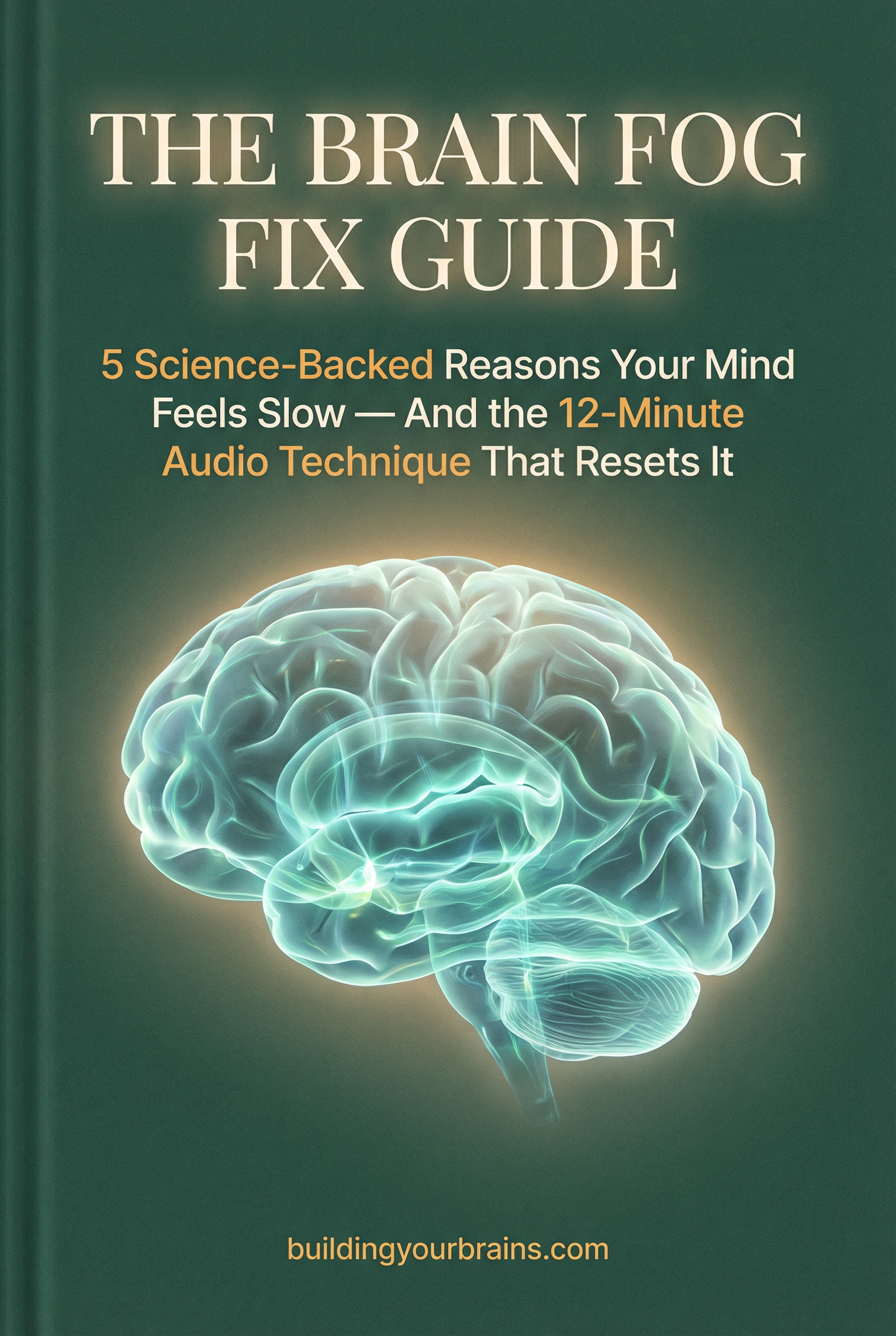
Download the free Brain Fog Fix Guide and discover the 12-minute audio technique that thousands use to restore mental clarity — no supplements, no meditation required.
Get the Free Guide →The Default Mode Network: Your Brain's Enemy of Focus
One of the most important discoveries in cognitive neuroscience over the past two decades is the Default Mode Network (DMN). This is a network of brain regions — primarily the medial prefrontal cortex, posterior cingulate cortex, and angular gyrus — that activates whenever external task demands are low.
In plain terms: the moment you are not actively engaged with a demanding task, your brain defaults to a self-referential, mind-wandering mode. You think about the past, the future, what others think of you, unresolved worries, social scenarios. This network is not defective — it plays important roles in creativity, social cognition, and memory consolidation. But it is the direct neurological antagonist of focused, present-moment attention.
The critical insight is that the DMN and the executive attention network operate in mutual inhibition: when one is active, the other is suppressed. Deep focus requires sustained DMN suppression. Mind-wandering — which research by Matthew Killingsworth at Harvard found occupies approximately 47% of waking hours — is the brain defaulting to DMN dominance.
This is why willpower alone does not produce sustained focus. Telling yourself to "just concentrate" does not address the underlying neurological competition. You need to understand and manipulate the conditions that favour executive network dominance over DMN activity. For a deeper exploration of this mechanism, read our article on why you can't focus.
DMN Suppression Strategies
Research points to several reliable DMN suppressors. High-challenge tasks that sit just above your current skill level create sustained executive network engagement — this is the neurological basis of flow. Mindfulness meditation, practiced over weeks to months, builds a literal thickening of the prefrontal cortex and trains the habit of noticing and returning from mind-wandering. And theta brainwave entrainment directly modulates the oscillatory patterns that determine which network dominates — a mechanism explored in depth in the brainwaves science hub.
Why Modern Life Makes Focus Neurologically Difficult
The human attentional system evolved in an environment radically different from the modern world. The ancestral environment had genuine intermittent demands — hunting, gathering, social navigation, predator detection — interspersed with genuine rest. Today, we have engineered an environment specifically designed to maximise interruption frequency.
The Dopamine Hijack
Every notification, every unread message count, every social media scroll delivers a micro-dose of dopamine — not from the reward itself, but from the anticipation of a potential reward. This is the variable-ratio reinforcement schedule that B.F. Skinner identified as the most addictive reward structure possible. Technology companies have explicitly designed for this mechanism.
The neurological consequence is that the brain becomes habituated to high-frequency low-quality dopamine stimulation. It upregulates dopamine tolerance and downregulates the dopamine reward from sustained, deep, effortful work — which delivers its payoff slowly and unpredictably. The brain becomes literally rewired to prefer distraction over focus.
Attention Residue
Professor Sophie Leroy at the University of Washington introduced the concept of attention residue to describe what happens after task-switching. When you switch from task A to task B, part of your working memory remains allocated to task A — processing incomplete items, replaying unresolved threads, anticipating returning to unfinished work. This cognitive residue actively degrades performance on task B.
Leroy's research found that incomplete tasks leave stronger residue than completed ones (the Zeigarnik effect). The practical implication: every time you check your email, your phone, or switch contexts mid-task, you are creating attentional residue that will degrade your next focused session. On average, it takes 23 minutes to fully return to deep focus after an interruption — a figure from Gloria Mark's research at UC Irvine that has significant implications for how we structure our working days.
Read our deep-dive on what digital distraction does to your brain for the full picture.
Chronic Stress and Cortisol
Chronic stress is one of the most direct neurological barriers to deep focus. Elevated cortisol degrades prefrontal cortex function — the exact region required for sustained attention. It induces high-beta wave dominance, characterized by anxious mental noise that prevents the brain from settling into the focused, moderate-beta or alpha state required for productive work. The relationship between stress and cognitive fog is explored in our complete brain fog guide.
Brainwave States and the Focus Window
Electroencephalography (EEG) research reveals that different cognitive states are characterised by distinct patterns of electrical oscillation across brain regions. Understanding these patterns illuminates why focus fails — and points directly to the most efficient interventions.
The Five Brainwave States
Delta (0.5–4 Hz): Deep, dreamless sleep. Virtually absent during waking hours in healthy adults.
Theta (4–8 Hz): The borderland of consciousness — drowsy, hypnagogic, meditative. Critical for creativity, insight, long-term memory consolidation, and — crucially — the entry point for flow states. Elite performers, experienced meditators, and creative geniuses all show elevated theta during their best work.
Alpha (8–12 Hz): Relaxed, unfocused awareness. Prominent when you close your eyes or enter calm contemplation. A bridge between active and passive states. The "idle" mode of a healthy, non-anxious brain.
Beta (12–30 Hz): Active thinking, problem-solving, engaged attention. Low-to-mid beta (12–18 Hz) is the productive focused state. High beta (18–30 Hz) is anxiety, rumination, and over-arousal — the state most people with focus problems inhabit.
Gamma (30–100 Hz): Burst-like patterns associated with peak cognitive performance, binding of information across brain regions, and moments of insight. Typically overlaid on theta during flow states.
The Optimal Focus Window
The neurological sweet spot for sustained deep work is a combination of moderate alpha at rest plus rapid transition to low-beta upon task engagement. The brain should be calm enough to avoid high-beta noise but aroused enough to sustain directed effort. The entry point for flow — the deepest form of focus — involves theta dominance, which is why experienced meditators and practiced creative workers can access flow more readily than those who have never trained this state.
For a comprehensive exploration of these brainwave states and how to actively shift between them, visit our complete brainwave science guide.
Flow State: The Peak of Human Focus
Hungarian-American psychologist Mihaly Csikszentmihalyi spent decades studying what he called optimal experience — states of total absorption in an intrinsically rewarding activity. He named this phenomenon "flow." Subsequent neuroscientific investigation has illuminated the brain mechanisms underlying what Csikszentmihalyi described phenomenologically.
Transient Hypofrontality
The key neuroscientific concept in flow is transient hypofrontality — a temporary reduction in prefrontal cortex activity during the flow state. This seems counterintuitive: if the prefrontal cortex is the seat of executive function, why would its downregulation produce peak performance?
The answer is that the prefrontal cortex, in its normal operating mode, is also the site of self-monitoring, self-consciousness, and critical self-evaluation — what psychologists call the inner critic. During flow, this self-monitoring is suppressed, freeing cognitive resources for purely task-directed processing. The subjective experience is effortlessness, loss of self-consciousness, and the sense that the work is happening through you rather than by you.
Simultaneously, EEG studies on flow states consistently show elevated theta power — particularly in frontal-midline theta, which is associated with focused internal attention and working memory engagement. This frontal theta synchrony during flow represents a unique neurological signature: the conscious monitoring circuits are quiet, but the deep processing circuits are maximally active.
The Challenge-Skill Balance
Csikszentmihalyi identified a critical precondition for flow: the task must sit at the exact intersection of your current skill level and the challenge presented. Too easy, and you fall into boredom and DMN activation. Too hard, and you experience anxiety and high-beta over-arousal. Flow lives in the narrow window where the challenge slightly exceeds your current ability — demanding full engagement without overwhelming capacity.
This has important practical implications. You cannot engineer flow through willpower alone. You need to design your work: calibrate task difficulty, remove competing attentional demands, and ideally prime your brain's electrical state before beginning. Our detailed guide on how to get into flow state covers the full protocol.
The Psychology and Neurology of Distraction
Distraction is not simply a failure of willpower. It has deep neurological and psychological roots that willpower-based strategies cannot reliably overcome.
Internal vs. External Distraction
External distraction — notifications, noise, interruptions — is familiar and relatively tractable. Remove the phone from the room, close the browser tabs, use noise-cancelling headphones. But research shows that the majority of mind-wandering originates internally, from the Default Mode Network, not from external stimuli. Your own thoughts — worries, daydreams, rumination — are the primary source of distraction in most focused work environments.
This is why environmental changes alone are insufficient. You also need to address the neurological conditions that make internal distraction more or less likely: stress levels, sleep quality, brainwave state, emotional arousal, and unresolved cognitive concerns (incomplete tasks, outstanding decisions, emotional preoccupations).
The Role of Emotional State
Research consistently shows that negative emotional states dramatically increase mind-wandering. Anxiety, frustration, loneliness, and boredom all increase DMN activity. Conversely, positive affect — curiosity, mild excitement, calm contentment — suppresses DMN and supports sustained executive attention.
This is why the pre-work mental state matters as much as the work environment itself. Attempting deep focus when you are emotionally dysregulated, sleep-deprived, or highly stressed is physiologically similar to trying to sprint on a broken leg — the underlying neurological machinery is compromised regardless of your effort.
Digital Distraction and Structural Changes
Chronic high-frequency distraction does not merely interrupt focus — it restructures the attentional system itself. Research by Clifford Nass at Stanford found that heavy multitaskers had measurably impaired attentional filtering — they were worse at ignoring irrelevant information even when they wanted to focus. The neural pathway for filtering distractions atrophies from disuse, just like a muscle that is never trained.
This suggests that extended periods of consistent, distraction-free deep work are not just productive in the moment — they are a form of attentional training that improves the underlying neurological capacity for focus.
The Focus Solutions Framework: Ranked by Evidence
Not all focus interventions are equal. Based on the neuroscience of attention, here is a hierarchy ranked by depth of effect and quality of evidence.
Tier 1: Neurological State Preparation
Before you even sit down to work, your brain is in a particular electrical state that either supports or undermines deep focus. If you are coming to your desk stressed, sleep-deprived, or emotionally activated, you are fighting the neurological current.
The most direct, evidence-based method for shifting into the optimal focus state is theta brainwave entrainment — using precisely engineered audio frequencies to guide the brain toward the calm-alert, theta-edged state where flow begins. The Try The Genius Song risk-free — $39 one-time, 90-day money-back guarantee. A 12-minute pre-work session can measurably shift your starting brainwave state, compressing the time to deep focus and extending the duration you can sustain it.
Tier 2: Environmental Design
Environmental design is the second tier — removing the external conditions that trigger attentional switching. This includes phone in another room (not silent-on-desk — physical absence reduces cognitive pull by measurable amounts even when the phone is face-down and silent, per research by Adrian Ward at UT Austin), website blockers during focus blocks, signal-free environments, and deliberate management of notification architecture.
Tier 3: Structural Work Protocols
Deep work protocols — whether Pomodoro, Cal Newport's time-blocking, or 90-minute ultradian rhythms — provide the temporal structure that the attentional system needs. The key principle is defending contiguous blocks of undivided attention long enough for genuine deep work to emerge. Our detailed comparison of Pomodoro vs. Deep Work vs. time blocking helps you choose the right system for your situation.
Tier 4: Lifestyle Foundations
Sleep, exercise, and nutrition are the fourth tier — essential but slow-acting foundations that create the neurological substrate for every other intervention to work. Sleep deprivation is the single most reliably destructive variable for attention performance, reducing prefrontal cortex efficiency far more than any stress or distraction. Aerobic exercise increases BDNF and improves theta power. Diet quality directly affects the neurotransmitter balance that modulates attentional systems.
The Genius Song
A professionally engineered 12-minute theta brainwave audio program. $39 one-time · Lifetime access · 90-day money-back guarantee via ClickBank.
Click here to try The Genius Song →Affiliate disclosure: This is an affiliate link. I may earn a commission at no extra cost to you.
Productivity Systems That Work With Your Brain
Once the neurological foundations are addressed, productivity frameworks provide the operational structure for sustained deep work. The key is selecting a system that aligns with how your brain's attentional system actually works — rather than one that fights it.
The 90-Minute Ultradian Cycle
Chronobiologist Peretz Lavie and sleep researcher Nathaniel Kleitman established that the brain operates on roughly 90-minute ultradian cycles throughout the day, just as it does during sleep. Peak cognitive performance tends to cluster in the first 60–80 minutes of each cycle, followed by a trough during which performance drops, mind-wandering increases, and the body sends subtle signals to rest (yawning, reduced concentration, hunger).
Working with rather than against these cycles means scheduling deep focus blocks in 90-minute increments, treating the inter-block rests as mandatory neurological recovery periods rather than laziness, and accepting that trying to push through the trough with caffeine or willpower simply delays the debt. The notorious 3pm energy crash — explored in our article on why you hit a wall at 3pm — is a particularly pronounced trough that responds well to a short theta entrainment reset rather than more coffee.
The Morning Priority Structure
Cortisol follows a predictable daily rhythm, peaking 20–30 minutes after waking (the Cortisol Awakening Response) and providing the neurological drive for focused, analytical work in the late morning. This means the hours between 9am and noon represent a neuroscience-confirmed window of peak executive function for most people.
Squandering this window on email processing, meetings, or administrative tasks — the cognitive equivalent of junk food — is one of the most common and most costly focus mistakes. The decision fatigue research shows that prefrontal willpower and executive function deplete over the day, making it essential to allocate your hardest cognitive work to your neurological prime time. Our full breakdown of decision fatigue and how to protect your best hours provides the practical framework.
Deliberate Practice vs. Mere Repetition
Psychologist Anders Ericsson's research on expert performance established that what matters is not just hours of practice but deliberate practice — focused engagement at the edge of current ability with immediate feedback. Deliberate practice is neurologically demanding precisely because it requires sustained executive control and continuous error-correction — the exact conditions that strengthen attentional circuitry over time. People who spend years doing deep, difficult cognitive work literally develop stronger, denser attentional networks.
Recovery as Part of the Focus System
One of the most consistent failures in productivity thinking is treating recovery as the absence of work rather than as an active component of peak performance. The neuroscience of attention indicates that genuine cognitive recovery — not just switching between tasks but actual defocused rest (the alpha and theta-dominant states of idle mind-wandering or relaxed walking) — is when the DMN performs its consolidation and creative recombination functions.
The best focus systems deliberately build in these recovery windows. Going for a walk without your phone. Looking out a window without stimulation. Meditating. These are not unproductive interruptions — they are neurologically essential maintenance periods that restore the executive attention network's capacity for the next focused block.
Music, Environment, and Pre-Work Rituals
The right auditory environment can either support or undermine focus, depending on your individual neurology and the nature of the task. Research distinguishes between tasks requiring verbal processing — where lyrics are almost universally harmful — and tasks requiring creative or sustained attention, where certain types of instrumental or engineered audio can support focus by masking distracting environmental noise and, in the case of binaural beats, directly modulating brainwave states. Our full analysis of the best music for focus examines the evidence for each approach.
Pre-work rituals are another underrated focus tool. The attentional system responds strongly to contextual cues — certain environments, routines, and sensory experiences that have been consistently paired with focused work become reliable triggers for the focused state. Building and defending a consistent pre-work ritual (same location, same first action, same audio environment) creates a Pavlovian conditioning effect that lowers the neurological cost of entering deep focus.
Frequently Asked Questions About Focus
Why does my focus seem worse in the afternoon?
The afternoon dip in focus — particularly the post-lunch slump around 2–3pm — is a genuine biological phenomenon driven by the convergence of the ultradian rhythm trough, post-meal blood glucose fluctuations, and a temporary dip in core body temperature. Cortisol levels also begin declining from their mid-morning peak. This is addressed in detail in our article on the afternoon energy crash.
Can ADHD be helped without medication?
Complementary strategies — structured environments, exercise, mindfulness, and brainwave entrainment — may support focus for people with ADHD as an adjunct to medical care. However, ADHD is a complex neurological condition and any approach to managing it should be developed in consultation with a qualified healthcare professional. Our article on how to focus with ADHD covers these strategies carefully, with appropriate medical context throughout.
How much does sleep deprivation affect focus?
The research is unequivocal: even mild sleep restriction (6 hours per night for two weeks) produces cognitive impairment equivalent to 48 hours of total sleep deprivation — and crucially, sleep-deprived subjects dramatically underestimate their own impairment. The prefrontal cortex is among the first brain regions to be degraded by sleep loss, meaning that your judgment about whether you are impaired is itself impaired. No focus system can compensate for consistent sleep insufficiency.
Is multitasking actually possible?
True cognitive multitasking — the simultaneous processing of two demanding tasks — is not possible for the human brain. What we call multitasking is rapid task-switching, which as discussed above incurs significant attentional residue costs. The persistent belief that some people are good multitaskers is not supported by the evidence; what varies is how quickly individuals recover from task-switching and how much residue they accumulate.