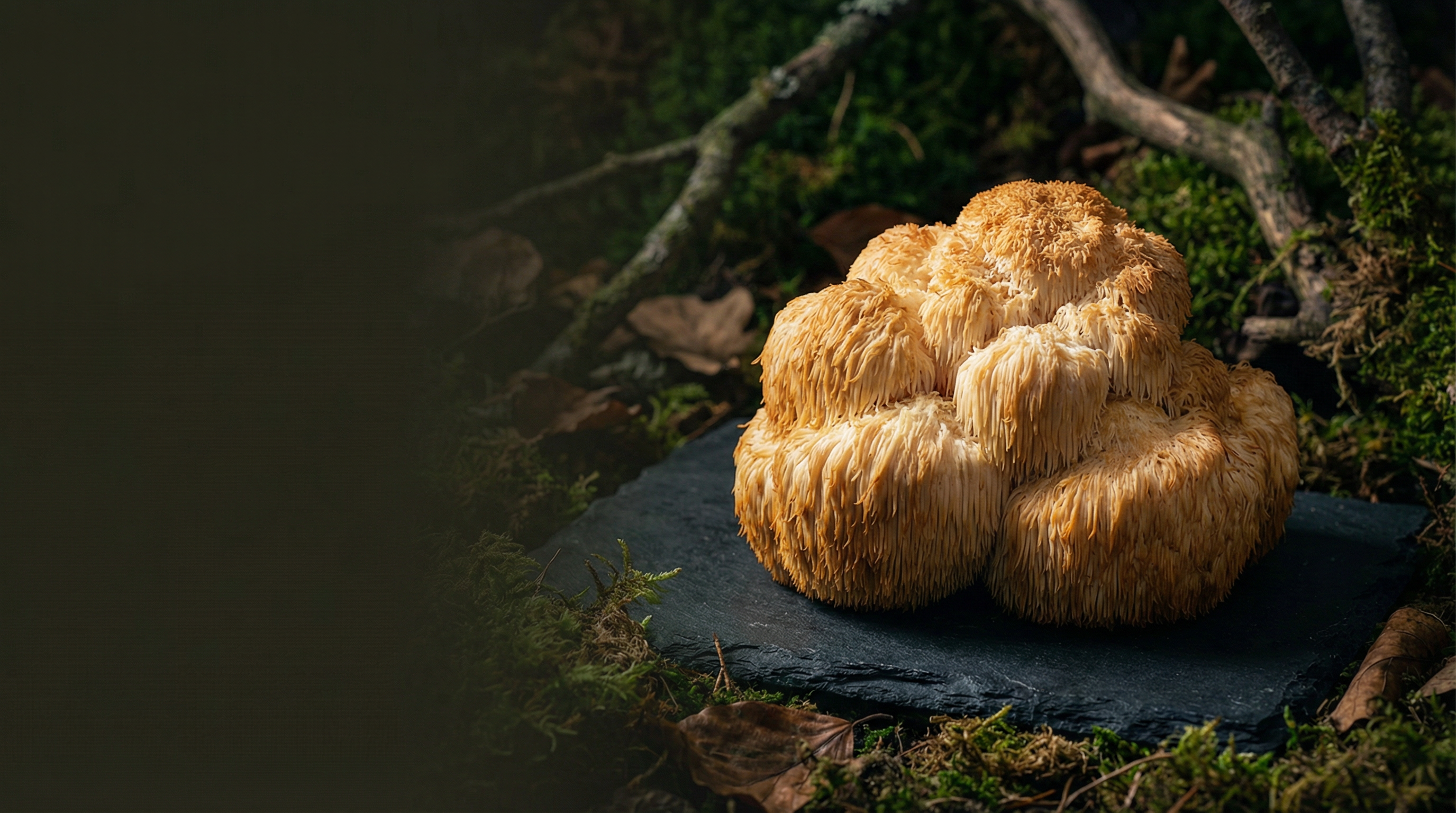

What Is Lion's Mane? The Basics
Hericium erinaceus — commonly called lion's mane — is a white, shaggy mushroom native to North America, Europe, and Asia. It's been used in traditional Chinese medicine for centuries, primarily for digestive and neurological health. Modern interest in it accelerated dramatically after researchers began identifying its unique neuroactive compounds: hericenones (found in the fruiting body) and erinacines (found in the mycelium).
These compounds have a remarkable property: they can cross the blood-brain barrier and stimulate the synthesis of Nerve Growth Factor (NGF). This is significant because NGF is one of the primary proteins responsible for the growth, maintenance, and survival of neurons in the brain and peripheral nervous system.
Is a Foggy Brain Holding You Back?
Download the free Brain Fog Fix Guide and discover the 12-minute audio technique that thousands use to restore mental clarity — no supplements, no meditation required.
Get the Free Guide →The NGF and BDNF Connection
To understand why lion's mane matters for brain health, you need to understand the neurotrophic factor system. NGF and BDNF (Brain-Derived Neurotrophic Factor) are proteins that the brain uses to grow new neurons, strengthen synaptic connections, and repair neuronal damage. Think of them as the brain's maintenance and growth hormones.
BDNF in particular is considered one of the most important molecules in cognitive health research. Low BDNF is associated with depression, cognitive decline, poor memory consolidation, and reduced neuroplasticity. High BDNF is associated with better learning, improved mood, greater cognitive resilience, and what researchers call "synaptic long-term potentiation" — the cellular mechanism of memory formation. For a deeper dive into BDNF, see our full article: What Is BDNF? The Brain Protein That Determines How Well You Remember.
Lion's mane's erinacines directly stimulate NGF synthesis, and NGF upregulation is associated with subsequent BDNF increases — they operate in interconnected pathways. This makes lion's mane one of the very few supplement compounds with a plausible, research-supported mechanism for genuinely supporting neuroplasticity.
What the Human Research Shows
The evidence base for lion's mane in human studies is growing, though still more limited than for omega-3s or bacopa. Key studies:
The Mori 2009 Study
A double-blind, placebo-controlled trial published in Phytotherapy Research tested 1g lion's mane extract three times daily (3g/day total) in 50–80-year-old Japanese adults with mild cognitive impairment. After 16 weeks, the lion's mane group showed significantly higher scores on cognitive function scales than the placebo group. Crucially, these improvements reversed within 4 weeks of stopping supplementation — suggesting the effect depends on continued use.
Anxiety and Depression Reduction
A 2010 study found that lion's mane powder at 2g/day for 4 weeks significantly reduced anxiety and depression scores in a group of overweight or obese adults. This is relevant to cognitive performance because anxiety and depression are among the primary causes of subjective cognitive impairment — and NGF has known mood-modulating effects.
Peripheral Nerve Regeneration Evidence
Animal studies have shown impressive nerve regeneration effects from erinacine A (found in lion's mane mycelium), with improved recovery from peripheral nerve injury. While animal data doesn't directly translate to human outcomes, the mechanism is the same neurotrophic factor pathway.
Dosing and Quality: Critical Variables
Many people try lion's mane and report no effect — and in most cases, the issue is dosing or product quality:
Dosing
Research uses 1–3g of standardised fruiting body extract per day. Many commercial products provide 300–500mg per capsule with a recommended dose of 1–2 capsules, putting the daily dose at 300–1,000mg — well below what the research uses. Expect to take 2–6 capsules of typical products to reach therapeutic dosing.
Fruiting Body vs. Mycelium
Hericenones — the most-studied active compounds — are found primarily in the fruiting body. Many cheaper products use mycelium grown on grain substrate, which contains primarily starch filler and very little active compound. Look for products that specify "fruiting body extract" and provide beta-glucan content (aim for ≥20% beta-glucans as an indicator of quality).
Timeline
Lion's mane is not an acute enhancer. Effects on NGF synthesis accumulate over weeks. Most people who benefit report noticing changes after 3–8 weeks of consistent use at adequate doses. Expecting a noticeable effect after a week is setting up for disappointment.
What Lion's Mane Doesn't Do
The marketing around lion's mane has become somewhat hyperbolic. Let's be specific about what the research does not support:
- It doesn't produce acute focus or energy (no evidence for this)
- It doesn't "reverse" established dementia or Alzheimer's (one study in MCI patients; no dementia reversal data in humans)
- It doesn't work immediately or dramatically — effects are gradual and modest in healthy adults
- The 300mg capsules in many "brain blend" products are likely below therapeutic threshold
For healthy young adults without cognitive impairment, the effect size will be smaller than in older adults or those with mild cognitive impairment. It may be working — supporting neuronal maintenance and reducing neuroinflammation — without producing subjectively noticeable changes.
Who Should Consider Lion's Mane
Based on the current evidence, lion's mane is most likely to produce noticeable benefits for:
- Adults 40+ with mild memory complaints or early cognitive decline
- Anyone with elevated neuroinflammation markers
- People recovering from nerve injury or concussion
- Those with anxiety or depression contributing to cognitive symptoms
For younger adults with primary goals of focus or productivity, the evidence base is thinner. That's not to say lion's mane has no value — its neuroprotective properties are worth considering — but expectation management matters.
What If You Could Stimulate BDNF Without Any Supplement?
Here's a question the lion's mane research raises: if BDNF is the underlying target — the protein that actually drives neuroplasticity, memory, and cognitive resilience — are there ways to increase it that don't require daily supplement capsules?
The answer is yes, and they're more powerful than any supplement. Aerobic exercise is the most potent BDNF booster known to science, producing larger BDNF increases than lion's mane with consistent exercise sessions. BDNF is also upregulated during specific brainwave states — particularly theta oscillations in the hippocampus. This is the frequency range activated during deep learning, REM sleep, and states of creative flow.
Which raises a fascinating implication: theta brainwave audio may support BDNF production through the same neurological pathway that sleep and meditation activate — by putting the brain into the oscillatory state most associated with neurotrophic factor release.
Instead of waiting 4–8 weeks for lion's mane to slowly nudge your NGF levels, a 12-minute daily theta session creates the neurological conditions for BDNF release directly. The two approaches aren't mutually exclusive — and together, they work at multiple levels simultaneously.
The Genius Song
A professionally engineered 12-minute theta brainwave audio program. $39 one-time · Lifetime access · 90-day money-back guarantee via ClickBank.
Click here to try The Genius Song →Affiliate disclosure: This is an affiliate link. I may earn a commission at no extra cost to you.
For the complete guide to drug-free brain enhancement, visit the Nootropics Alternative pillar page. And for a deep dive into how brainwave states govern the same neuroplasticity processes lion's mane is trying to support, see our comprehensive brainwave science guide.