What Is the Default Mode Network?
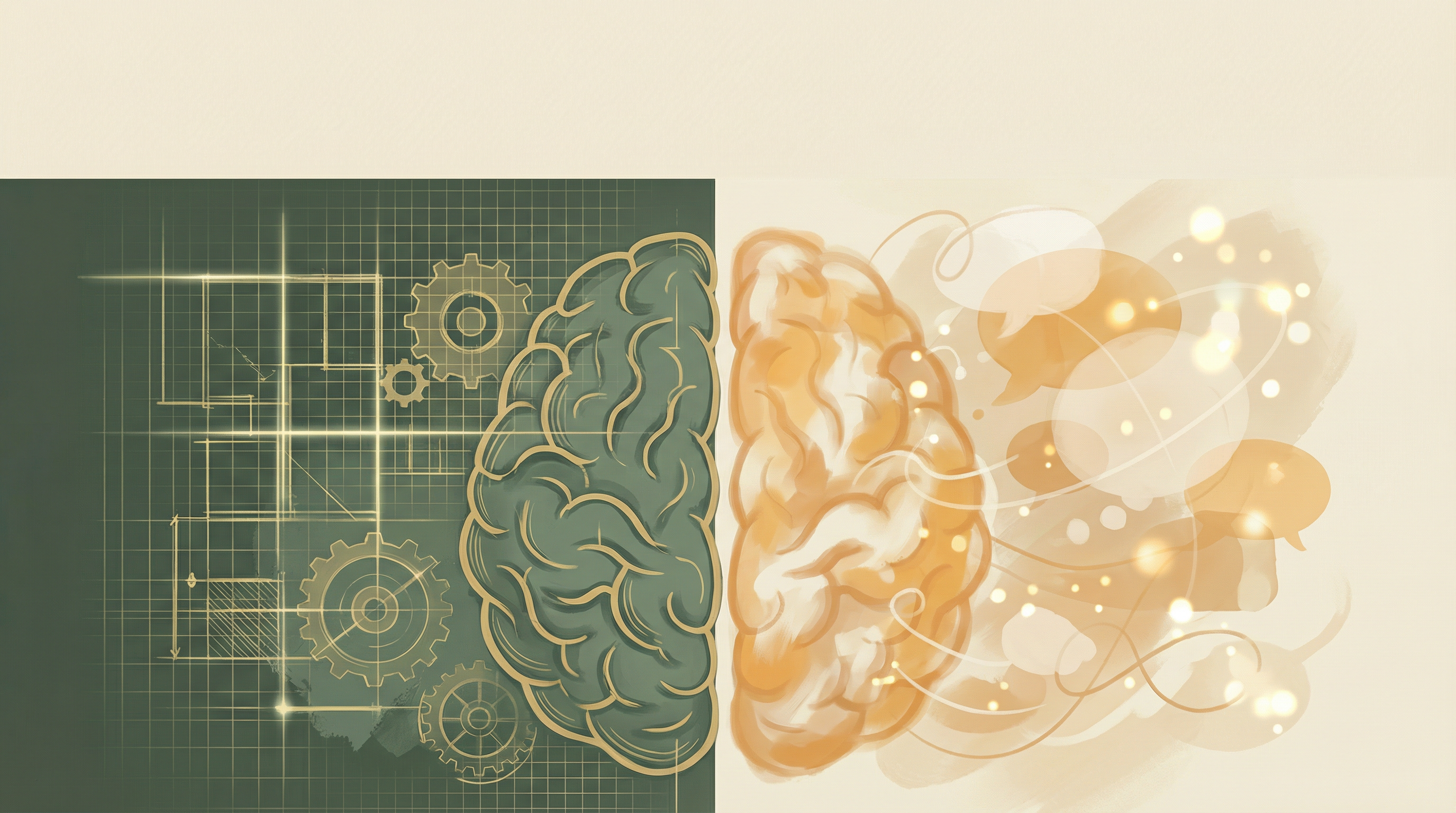
In the late 1990s, neuroscientist Marcus Raichle made a discovery that upended the conventional model of the brain. Using functional MRI scans, he observed that the brain does not simply "rest" when not actively engaged in a task. Instead, a specific and consistent network of brain regions becomes more active during periods of reduced external demand — particularly the medial prefrontal cortex, the posterior cingulate cortex, and the angular gyrus.
He called this the Default Mode Network (DMN): the brain's default operating state when it is not being directed toward an external goal. Subsequent research revealed the extraordinary extent to which the DMN dominates waking experience. A landmark study by Matthew Killingsworth and Daniel Gilbert at Harvard, published in Science, found that humans spend approximately 47% of their waking hours not thinking about what they are actually doing. The mind is wandering to other times, places, people, and concerns for roughly half of every waking day.
What the DMN Actually Does
The DMN is not purely a distraction system. It serves important functions: autobiographical memory retrieval, mental simulation of future scenarios, social cognition (imagining other people's perspectives), and creative recombination of existing knowledge. Many moments of creative insight — the shower epiphany, the solution that arrives on a morning walk — emerge from DMN activity.
The problem is not the DMN itself. The problem is a DMN that will not quieten when you need to focus — one that intrudes on deliberate work, hijacks working memory with off-task thoughts, and makes sustained attention feel like constantly swimming against a current.
Is a Foggy Brain Holding You Back?
Download the free Brain Fog Fix Guide and discover the 12-minute audio technique that thousands use to restore mental clarity — no supplements, no meditation required.
Get the Free Guide →The DMN vs. Your Attention System
The brain's executive attention network — centred on the dorsolateral prefrontal cortex and the anterior cingulate cortex — is the functional opposite of the DMN. When the attention network is active and engaged, the DMN is suppressed. When the DMN is active, the attention network is suppressed. These two networks exist in a state of mutual inhibition: the brain cannot fully occupy both states simultaneously.
This mutual inhibition is the neurological mechanism behind every experience of mind-wandering during work. When the difficulty of a task doesn't sufficiently engage the executive attention network — or when stress, fatigue, emotional preoccupation, or simple habit patterns allow the DMN to assert itself — focus breaks.
The 47% Problem
The Killingsworth-Gilbert study made a second important finding that is less often quoted: mind-wandering made people less happy, regardless of what they were thinking about. Even when people's wandering thoughts turned to pleasant subjects, they reported lower happiness than when they were absorbed in what they were actually doing. The DMN is not a refuge. It is associated with rumination, self-criticism, social comparison, and anticipatory anxiety as much as with pleasant daydreaming.
This means that the inability to focus is not just a productivity problem. It is associated with lower subjective wellbeing, higher rates of depression and anxiety, and the corrosive mental habit of spending your life partly elsewhere, always. Addressing difficulty concentrating is therefore not merely about getting more done — it is about the quality of your conscious experience.
Why Willpower Alone Doesn't Work
The conventional advice for focus problems is fundamentally willpower-based: try harder, be more disciplined, eliminate distractions, set timers. While some of these strategies have value, they all assume the problem is primarily motivational rather than neurological. This assumption is wrong — and understanding why it is wrong is liberating.
The Resource Depletion Model
Roy Baumeister's ego depletion research (later somewhat controversial in replication attempts, though the broad phenomenon is widely supported) showed that executive control — including the ability to suppress the DMN and maintain deliberate focus — is a limited resource that depletes with use. Every act of resisting distraction, making a decision, or forcing attention back to a task costs something from a finite mental resource pool.
This means that willpower-based focus strategies have an inherent ceiling. You can use willpower to get back to work after a distraction, but repeated use of willpower throughout a work session depletes the resource available for subsequent focused periods. It is cognitively expensive to maintain focus this way — and eventually, the resource runs out.
The Emotional State Problem
Willpower strategies also fail because they do not address emotional state — and emotional state is one of the strongest predictors of DMN activity. Anxiety, frustration, loneliness, boredom, and unresolved emotional concerns all directly activate the DMN. Telling yourself to "just focus" when you are genuinely stressed or emotionally activated is physiologically similar to telling yourself to be calm during an adrenaline spike. The instruction does not override the biological state.
This is especially relevant in the context of the brain fog that often accompanies chronic stress. Our article on the complete causes of brain fog explores how cortisol and emotional dysregulation combine to make mental clarity feel impossible — a problem that is neurological, not motivational.
The Brainwave Root of the Problem
Perhaps the most useful insight from neuroscience for understanding focus failure is the brainwave dimension. EEG research reveals that the DMN's activity is associated with specific oscillatory patterns — and that these patterns can be measurably shifted by targeted interventions.
Most people struggling with focus are living in a state of high-beta dominance (18–30 Hz) — the electrical signature of anxiety, over-arousal, and mental noise. High-beta is not a focused state. It is a hypervigilant, distracted state where the brain is scanning for threat, cycling through worries, and generating the constant background chatter that makes sustained attention impossible.
The brainwave state associated with optimal focus — and particularly with flow, the deepest form of focused performance — is a combination of alpha and theta. Alpha (8–12 Hz) represents the relaxed, calm baseline from which focused attention easily emerges. Theta (4–8 Hz) underlies the deepest creative work, memory encoding, and the flow state itself.
Understanding that your inability to focus may be rooted in your brain's electrical state — rather than your character or discipline — transforms the solution space. The question becomes not "how do I try harder?" but "how do I shift my brain's operating frequency?" Our full guide to binaural beats for focus and brainwave entrainment explains the science behind this approach in depth.
What Actually Suppresses the DMN
Given the neurological roots of focus difficulty, effective solutions must address the DMN-attention network balance directly rather than relying on willpower escalation.
1. Theta Brainwave Entrainment
The most direct intervention on the brainwave dimension is theta entrainment — using precisely engineered audio frequencies to guide the brain toward the theta-alpha state where DMN suppression naturally occurs and focused attention becomes easier to enter and sustain. A 12-minute pre-work session using a quality theta entrainment program can measurably shift your starting state, reducing the neurological cost of entering deep focus.
2. Mindfulness Training
Mindfulness meditation has some of the most robust neuroscientific evidence for improving attentional control. Multiple neuroimaging studies show that regular mindfulness practice thickens the prefrontal cortex, strengthens the connection between the executive attention network and regions that monitor and catch mind-wandering, and reduces habitual DMN reactivity. The effect sizes are meaningful, but the time investment is substantial — typically 8+ weeks of consistent practice before clear results emerge.
3. Environmental Distraction Removal
While environmental changes do not directly address the DMN, they lower the frequency of external triggers that activate it. Research by Adrian Ward at UT Austin showed that the mere visible presence of a smartphone — even face-down, even silent — reduces available cognitive capacity, because part of the prefrontal cortex is continuously engaged in resisting the impulse to check it. Physical removal of the phone from the work environment measurably improves performance on cognitively demanding tasks.
4. Challenge Calibration
The executive attention network is most effectively suppressed — and the DMN most reliably silenced — when a task sits at the edge of current skill. Tasks that are too easy allow the mind to wander because the attentional system is not fully engaged. By deliberately calibrating task difficulty — breaking problems into the hardest sub-problems you can meaningfully engage, seeking the edge of understanding rather than the comfortable middle — you create the neurological conditions for DMN suppression.
5. Stress and Cortisol Management
Chronic stress is a powerful driver of the high-beta DMN-active state that makes focus so difficult. Managing cortisol through adequate sleep, regular aerobic exercise, social connection, and deliberate recovery periods addresses the neurological roots of attention failure rather than just its symptomatic expression. See our full guide to deep focus techniques for the complete evidence-based framework.
The inability to focus is not a character flaw. It is a neurological challenge with neurological solutions. The brain can be trained — its oscillatory patterns shifted, its attentional circuitry strengthened — through the right combination of environmental design, lifestyle factors, and direct brainwave intervention. Starting with understanding the DMN is the most important first step.