| Feature | Binaural Beats | Isochronic Tones |
|---|---|---|
| Mechanism | Brain creates phantom beat from two different frequencies | Single tone pulsed on/off at target frequency |
| Headphones required? | Yes — essential | No — works through speakers |
| EEG entrainment strength | Moderate | Stronger (more direct stimulus) |
| Subjective experience | Smoother, more subtle | More pronounced, rhythmic pulsing |
| Best frequency range | All ranges — particularly theta/alpha | Particularly effective for alpha and beta |
| Comfort for long sessions | Higher — less fatiguing | Lower — pulsing can become tiring |
| Research evidence | More studies available | Fewer studies, but strong mechanism evidence |
How Binaural Beats Work
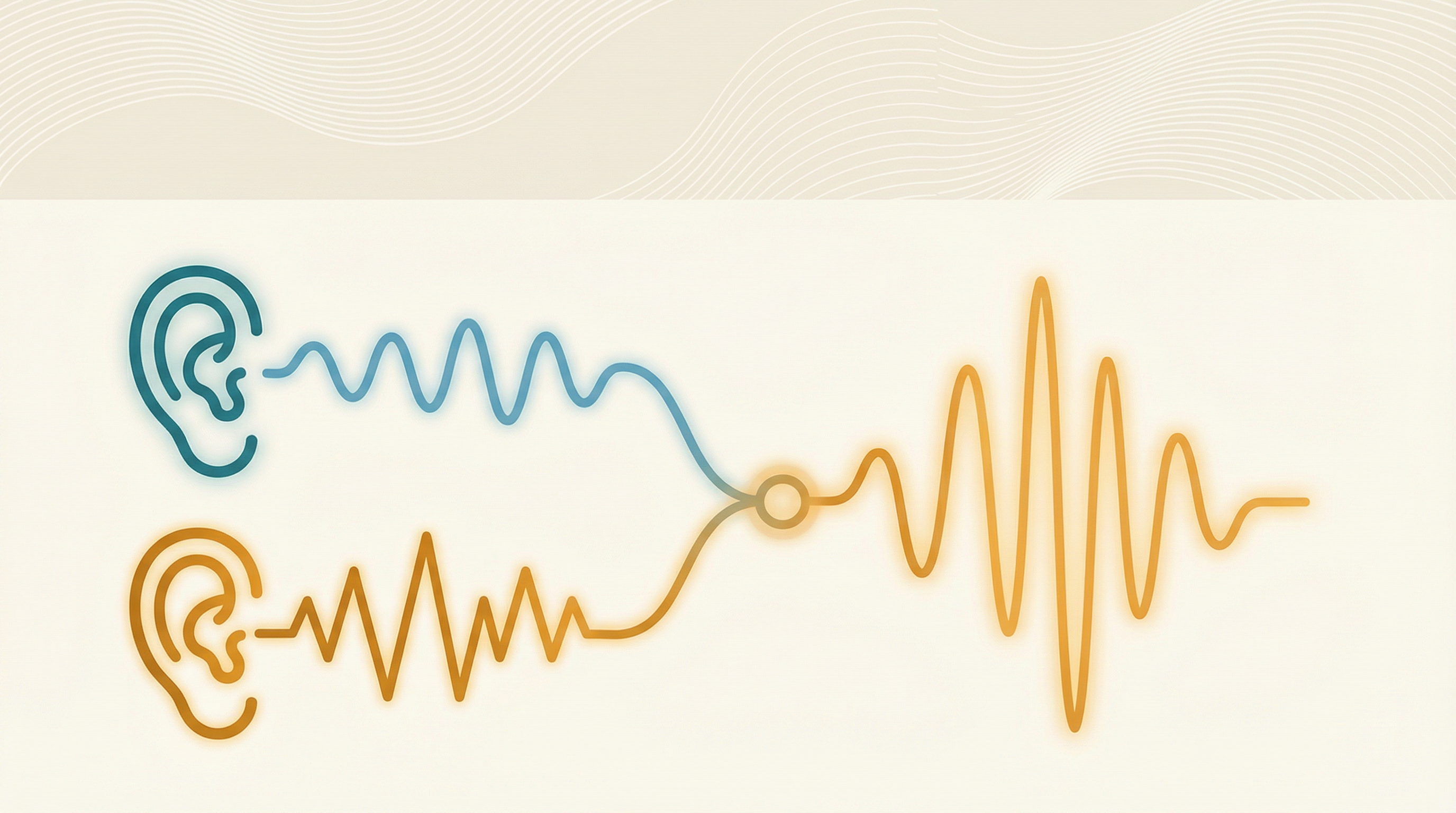
As covered in depth in our article on whether binaural beats work, the mechanism is the brain's generation of a phantom "beat" from two slightly different frequencies delivered to each ear separately. If your left ear receives 200 Hz and your right ear receives 206 Hz, your brain perceives a 6 Hz beat — a theta-range frequency.
This beat is not a real acoustic event; it is created within the auditory brainstem and then propagated to the cortex, where it can trigger the frequency following response — the brain's tendency to synchronise its own electrical oscillations with the perceived rhythm. The key limitation is that this mechanism requires precise stereo separation: headphones are mandatory.
The neurological pathway for binaural beats is primarily auditory: the beat is perceived as a sound (albeit an internal one), and the cortical entrainment follows from that perception. This means the binaural beat experience is smooth and relatively subtle — many users describe it as a gentle pulsing or wavering sensation in the audio, rather than a strong rhythmic pulse.
Is a Foggy Brain Holding You Back?
Download the free Brain Fog Fix Guide and discover the 12-minute audio technique that thousands use to restore mental clarity — no supplements, no meditation required.
Get the Free Guide →How Isochronic Tones Work
Isochronic tones use a completely different approach. A single tone is switched on and off at the target frequency — so for 6 Hz theta entrainment, you would hear a tone that pulses 6 times per second with sharp onset and offset between each pulse. This creates a distinctly rhythmic, "ticking" quality to the audio.
Because isochronic tones are real acoustic events — not internally generated beats — they produce a more direct and immediate rhythmic stimulus. The auditory cortex responds to each pulse onset and offset, generating neural firing at the same rhythm. This more direct stimulus means that isochronic tones typically produce stronger and faster EEG responses than binaural beats at equivalent frequencies.
Crucially, isochronic tones do not require headphones. The stimulus is present in the actual sound waves and reaches both ears identically. This makes them more practical for use in settings where headphones are inconvenient — though background noise can reduce their effectiveness by masking the pulsing rhythm.
What the Research Shows About Each Method
The honest assessment is that binaural beats have considerably more peer-reviewed research behind them, simply because they were identified and studied first. The body of controlled trials on binaural beats spans more than two decades and covers anxiety, memory, pain, and sleep, with generally positive results. See our full evidence review in the binaural beats research article.
Isochronic tones have fewer dedicated clinical trials, but the mechanistic evidence is actually stronger in some respects. A 2011 study by Trost and Vuilleumier comparing EEG responses to binaural beats and isochronic tones at the same target frequency found that isochronic tones produced larger amplitude EEG changes. This suggests that per unit of listening time, isochronic tones may deliver more efficient entrainment — but more research is needed to confirm whether larger EEG amplitude changes translate to superior cognitive outcomes.
For the biohacker community, this comparison sits within the broader discussion of cognitive optimisation that we cover in our brain biohacking guide.
Practical Differences That Matter
Headphone requirement
This is the most practically significant difference. If you cannot or prefer not to use headphones — during a walk, while doing light work at a standing desk, during an outdoor rest — isochronic tones are your only audio entrainment option. Binaural beats simply do not work without stereo headphone delivery.
Session length tolerance
The rhythmic pulsing of isochronic tones can become fatiguing during sessions longer than 20–30 minutes. Binaural beats, being perceptually smoother, are more comfortable for extended 45–60 minute sessions. For a 12-minute targeted session, this difference is largely irrelevant.
Frequency range effectiveness
Isochronic tones become less effective at very low frequencies (below 2–3 Hz) because the slow pulsing rhythm is harder for the brain to track as an entrainment signal. Binaural beats have no such lower limit from the pulsing perspective, making them better for delta entrainment (0.5–4 Hz). For theta and above, both methods are effective.
Which Should You Choose?
For most people seeking theta entrainment for creativity, memory, and stress reduction:
- If you will use headphones consistently: binaural beats or a combined approach
- If you cannot always use headphones: isochronic tones
- For the fastest EEG entrainment per session: isochronic tones
- For the most comfortable extended session: binaural beats
- For the most thoroughly tested approach: binaural beats
The most pragmatic answer for serious users is a program that combines both techniques. Many premium entrainment recordings layer isochronic tones and binaural beats simultaneously — the isochronic component provides the direct rhythmic stimulus while the binaural component adds depth and a smoother perceptual texture. This combined approach leverages the strengths of both methods.
The Genius Song
A professionally engineered 12-minute theta brainwave audio program. $39 one-time · Lifetime access · 90-day money-back guarantee via ClickBank.
Click here to try The Genius Song →Affiliate disclosure: This is an affiliate link. I may earn a commission at no extra cost to you.
Frequently Asked Questions
Are isochronic tones better than binaural beats?
Neither is universally superior. Isochronic tones produce stronger EEG responses per session and work without headphones. Binaural beats have more research behind them, are more comfortable for long sessions, and are more effective in the very low delta range. The best entrainment programs combine both techniques to leverage the advantages of each.
Do isochronic tones work without headphones?
Yes. Unlike binaural beats, isochronic tones are real acoustic events rather than internally generated phantom beats. They can be delivered through speakers effectively, though headphones improve the experience by eliminating ambient noise. Binaural beats are completely non-functional through speakers.
Can you combine isochronic tones and binaural beats?
Yes, and this is what many premium programs do. Layering both methods simultaneously provides a stronger and broader entrainment stimulus — the direct rhythmic input of isochronic tones combined with the smoother, deeper effect of binaural processing. Most users find the combined approach more effective than either method alone.