The Case for Free: What YouTube Gets Right
Let's be fair to free resources first. The best free binaural beats recordings on YouTube can produce real relaxation effects. Many creators genuinely understand the technology and upload high-quality source recordings. If your goal is simply to unwind at the end of a long day and you are not concerned with precise neurological targeting, a free recording played through good headphones in a quiet room can deliver a pleasant, calming experience.
Free resources also have an important role in introduction — giving someone new to brainwave entrainment a low-risk way to experience the technology before investing in a paid program. In this context, they serve a useful purpose.
The problem is not that free recordings are malicious or fraudulent. The problem is that the technical pipeline through which free recordings reach your ears fundamentally compromises the precision that effective entrainment requires.
Is a Foggy Brain Holding You Back?
Download the free Brain Fog Fix Guide and discover the 12-minute audio technique that thousands use to restore mental clarity — no supplements, no meditation required.
Get the Free Guide →The Audio Compression Problem
This is the most critical issue, and it is not widely understood. Binaural beats work because of the precise frequency difference between the tone in your left ear and the tone in your right ear. If that difference is 6 Hz, your brain generates a 6 Hz beat. If it is 6.3 Hz due to audio distortion, you get a beat that wanders between roughly 5.5 and 7 Hz — and the entrainment precision is significantly degraded.
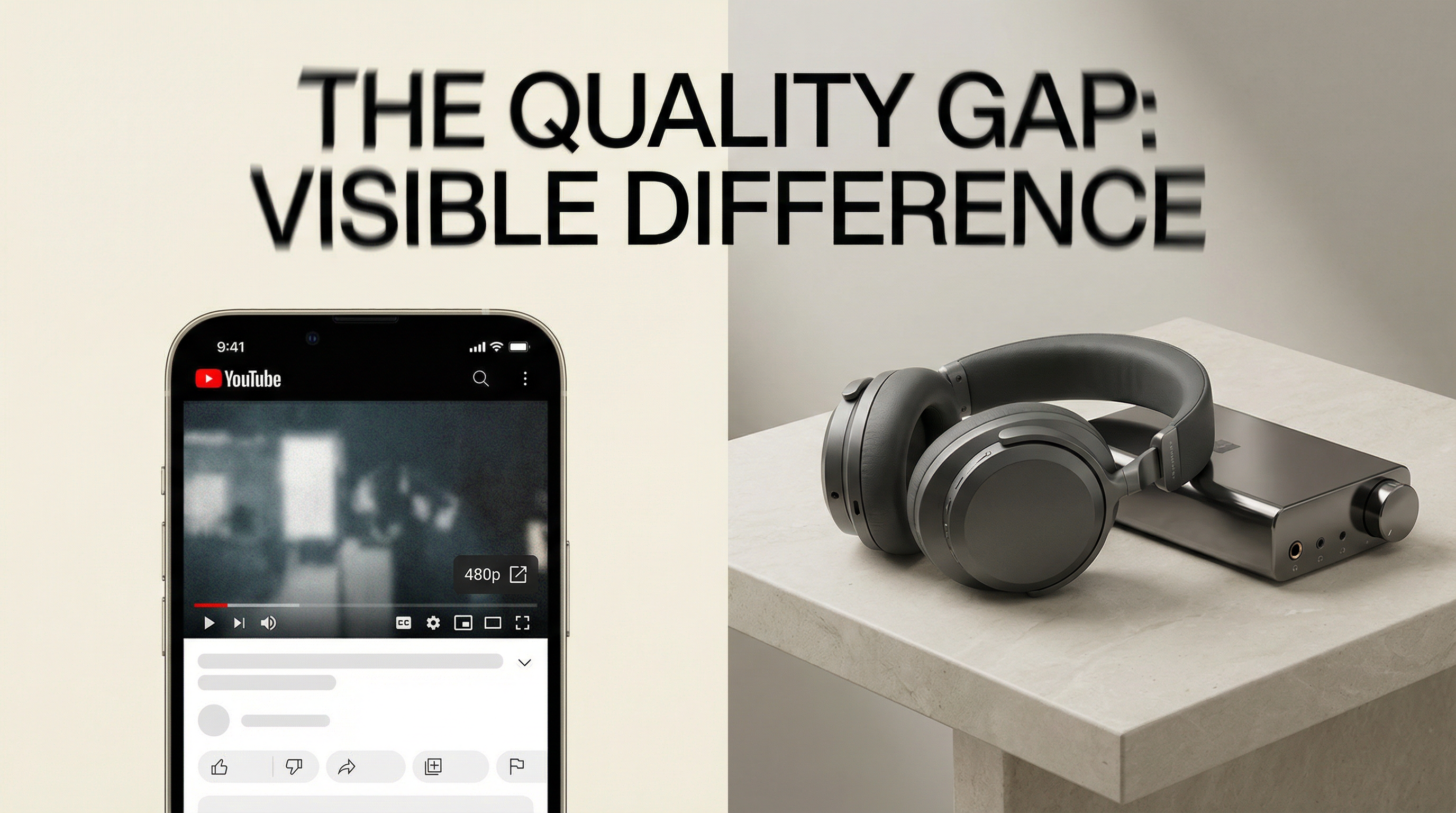
YouTube applies heavy audio compression to all uploaded content. The platform re-encodes audio at approximately 126 kbps AAC, regardless of the quality of the original upload. This is a lossy compression format that distorts the precise frequency relationships that binaural beats depend on. The carrier frequencies — the base tones that the beat rides on — need to be precise to within fractions of a hertz for maximum entrainment effectiveness. YouTube's compression routinely introduces frequency deviations that exceed this tolerance.
Additionally, YouTube's audio normalisation algorithms actively modify the dynamic range and volume envelope of uploaded content. Binaural beats have specific amplitude characteristics that research has shown matter for entrainment depth — a uniform steady volume produces different EEG responses than carefully designed volume envelopes with gradual swells and fades. YouTube flattens these nuances.
The Session Design Difference
Beyond audio quality, there is a second critical difference: session architecture. Most YouTube binaural beats recordings do one of two things: either a fixed frequency for the entire duration (e.g., 6 Hz theta for 30 or 60 minutes), or a gradual sweep from one frequency to another.
Research on optimal entrainment protocols suggests that neither of these approaches is ideal. The brain does not respond equally to all theta frequencies — there is a range, and different frequencies within the theta band have different effects. The most effective sessions sweep through the theta range (starting at, say, 7 Hz, descending through 6 Hz to 4 Hz, then returning to 6 Hz) in a way that maintains the brain's responsiveness and prevents habituation.
Professionally designed entrainment programs are built around this research. The frequency sweeping, the transition rates, the carrier frequency selection, the background music's relationship to the beat frequency — all of these are engineered to maximise and maintain the entrainment response over a 12–20 minute session. This level of design is essentially absent from typical YouTube uploads.
Carrier Frequency: Why 100 Hz Minimum Matters
A detail often overlooked in free recordings is the carrier frequency — the base tone that the beat is built on. Research has shown that the binaural beat effect is strongest when carrier frequencies are between 100 Hz and 1000 Hz. Below about 100 Hz, the auditory system's ability to process the binaural beat degrades significantly.
Many low-quality free recordings use carrier frequencies well below 100 Hz — often because the producers choose frequencies that sound pleasant or mysterious, not frequencies that produce optimal entrainment. A recording with carrier frequencies of 40 Hz and 46 Hz sounds eerie and otherworldly, but the 6 Hz binaural beat it generates will be substantially weaker than the same beat generated from 200 Hz and 206 Hz carriers.
This is not a negligible technical detail — it can mean the difference between a recording that produces measurable EEG changes and one that produces primarily a placebo effect.
The $39 vs. Free Comparison: What You Actually Get
Let's put the numbers in context. A professionally engineered theta entrainment program at $39 one-time represents a trivially small investment compared to:
- A single session with a cognitive performance coach ($150–400/hour)
- A month's supply of nootropic supplements ($80–200/month)
- A mindfulness app subscription ($70–100/year) that may or may not move your EEG
- A single therapy session ($100–200/session)
The $39 question is really: "Am I willing to pay for the precision that makes the technique actually work?" Given that the primary mechanism (frequency precision) is genuinely compromised by free YouTube recordings, this is not a luxury-versus-budget decision — it is a function-versus-placebo decision for many users.
The 90-day money-back guarantee removes the financial risk entirely. If you use a quality program daily for 60–90 days and find no benefit, the guarantee means you are no worse off than if you had stuck with YouTube recordings.
For more context on the nootropics comparison — how audio entrainment stacks up against supplements for cost-effectiveness — see our nootropics alternative guide.
The Genius Song
A professionally engineered 12-minute theta brainwave audio program. $39 one-time · Lifetime access · 90-day money-back guarantee via ClickBank.
Click here to try The Genius Song →Affiliate disclosure: This is an affiliate link. I may earn a commission at no extra cost to you.
What to Look for in a Quality Binaural Beats Program
Whether you choose The Genius Song or another program, here are the technical criteria to evaluate:
- Audio format: WAV, FLAC, or 320 kbps MP3 minimum — not compressed streaming audio
- Carrier frequencies: Base tones at 100–500 Hz range for optimal beat perception
- Session design: Gradual frequency sweeping rather than fixed single frequency
- Duration: 12–20 minutes minimum for meaningful entrainment
- Background audio: Designed to complement rather than mask the entrainment frequencies
- Money-back guarantee: Any credible program should offer one — 30-day minimum, 90-day preferred
For the research on what binaural beats can and cannot deliver, see the full evidence review in our article on whether binaural beats work.