How Cortisol Rewires Your Brain
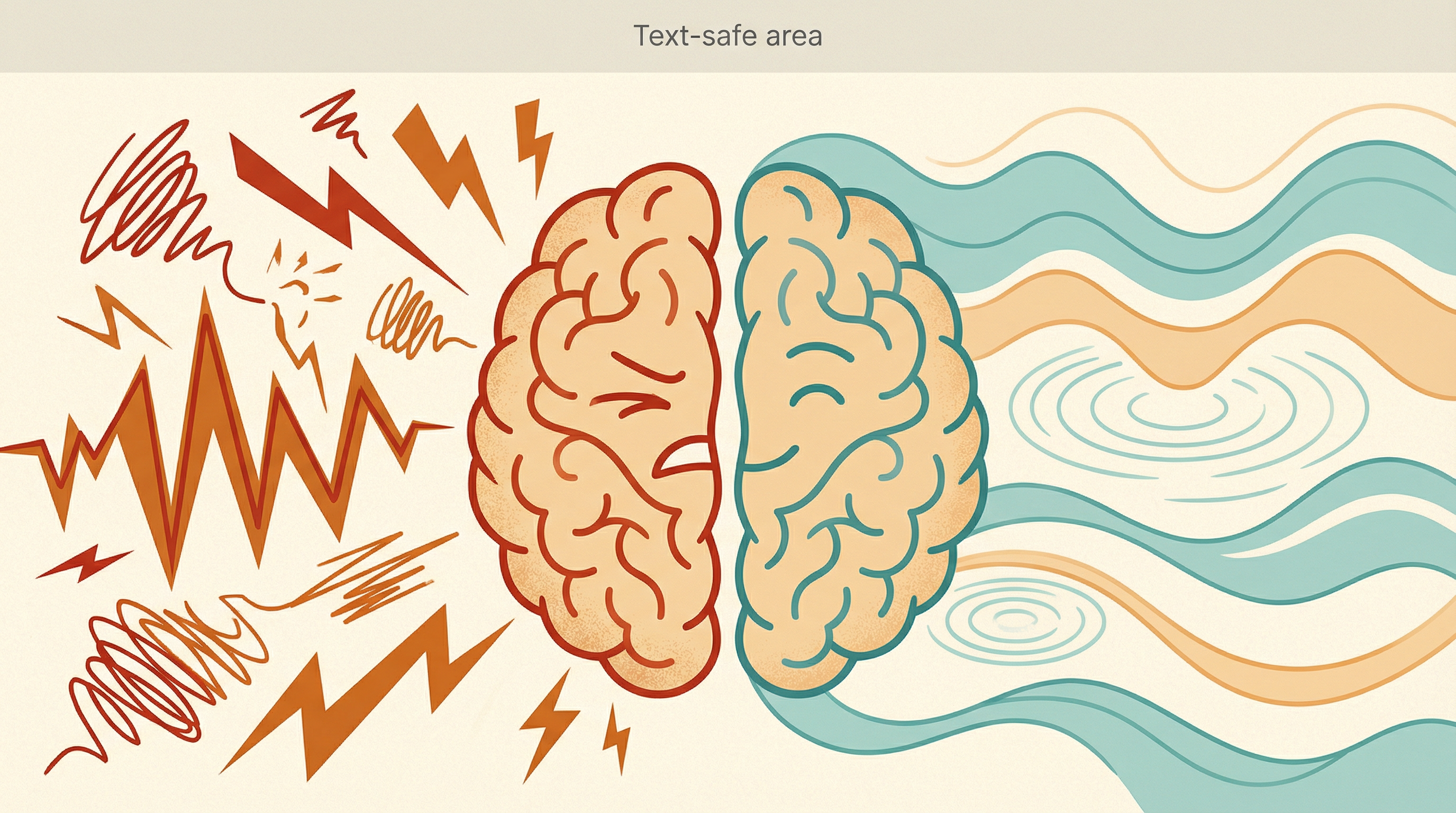
Cortisol is your primary stress hormone — produced by the adrenal glands in response to perceived threat, real or imagined. In its acute form, it is a useful neurochemical: sharpening attention, mobilising energy, priming survival responses. The human stress response evolved to handle short-term physical threats — a predator, a fight, a fall. Cortisol was designed to spike, do its job, and clear.
What it was not designed for is the relentless, low-grade, never-resolved stress of modern life: financial pressure, relationship strain, work demands, digital overstimulation, and the background anxiety of a 24-hour news cycle. When cortisol remains chronically elevated — day after day, week after week — it stops being a performance enhancer and becomes a neurotoxin.
Cortisol's Effect on the Hippocampus
The hippocampus is one of the brain's most vulnerable structures. It plays a central role in forming new memories, consolidating learning, and contextualising emotional responses. It is also unusually dense with cortisol receptors — which means it is one of the brain regions most directly affected by chronic stress.
Research published in Nature Neuroscience showed that chronic stress exposure causes measurable hippocampal volume reduction — the physical shrinking of brain tissue. This is not metaphorical. Stress literally reduces the size of the structure responsible for memory and learning. The clinical result is the forgetfulness, word-finding difficulties, and learning impairments that so closely mimic the experience of brain fog.
Cortisol's Effect on the Prefrontal Cortex
The prefrontal cortex (PFC) is the seat of executive function — planning, decision-making, impulse control, and abstract reasoning. It is also extraordinarily sensitive to stress hormones. Under chronic cortisol exposure, glutamate accumulation in PFC synapses disrupts the precise synchrony required for complex cognitive tasks. The PFC becomes noisy, inefficient, and slow.
This is why stress-related brain fog feels particularly concentrated in executive function: you can't plan, can't prioritise, can't make decisions, can't think clearly about complex problems. Your PFC is under active neurochemical assault.
Is a Foggy Brain Holding You Back?
Download the free Brain Fog Fix Guide and discover the 12-minute audio technique that thousands use to restore mental clarity — no supplements, no meditation required.
Get the Free Guide →Beta-Wave Lock-In: The Electrical Dimension of Stress
Beyond the hormonal effects, chronic stress has a direct and measurable impact on your brain's electrical activity. Normally, the brain moves fluidly between brainwave states — beta during focused work, alpha during relaxed attention, theta during light meditation or the hypnagogic state before sleep, delta during deep sleep. This flexibility is itself a marker of cognitive health.
Chronic stress induces a state neuroscientists call high-beta lock-in: the brain becomes stuck at the anxious, over-aroused end of the beta range (18–30 Hz). High-beta is characterised by racing thoughts, heightened reactivity, difficulty filtering irrelevant information, and the subjective experience of mental noise — your brain is generating too much electrical activity in the wrong pattern.
What makes this especially problematic is that high-beta directly suppresses theta production. And theta (4–8 Hz) is the brainwave state associated with calm clarity, creative insight, memory consolidation, and — crucially — the restoration of prefrontal executive function. When you're locked in high-beta stress, you are neurologically prevented from accessing the mental state that would allow you to think clearly and feel calm.
This is why stress relief and cognitive clarity are not separate goals — they are the same goal, approached from different angles. For a deep dive into brainwave science, see our complete guide to brainwave types.
The Stress-Fog Vicious Cycle
Chronic stress creates a self-reinforcing cycle that is important to understand if you want to break out of it:
- Stress elevates cortisol, impairing hippocampal and prefrontal function
- Cognitive impairment makes tasks harder to complete, creating more stress
- Sleep is disrupted by elevated evening cortisol and high-beta arousal
- Poor sleep further impairs cognitive performance and stress resilience
- Reduced cognitive performance generates more anxiety about performance
- The cycle repeats and deepens
Simply trying harder to focus while this cycle is running is like trying to accelerate a car while the handbrake is on. You can't willpower your way out of a cortisol-driven neurological impairment. The intervention needs to address the physiology, not increase the demand on a brain that is already overwhelmed.
If you're wondering whether your cognitive symptoms might have a more complex relationship with mood, our article on brain fog vs depression addresses this distinction carefully.
Theta State as the Cortisol-Reducing Fix
The most direct way to break the stress-fog cycle is to restore the brain's access to the theta state — the frequency that is actively suppressed by high-beta stress, and that directly counteracts cortisol's neurological effects.
Theta brainwave activity is associated with activation of the parasympathetic nervous system — the "rest and restore" branch that counteracts the fight-or-flight stress response. When the brain produces theta, cortisol production drops. The hippocampus and prefrontal cortex are relieved of their cortisol load. Synaptic function in the PFC improves. The electrical noise of high-beta decreases. Mental clarity returns.
This is what experienced meditators achieve with dedicated practice — their brains have learned to produce theta on demand. EEG studies of long-term meditators consistently show robust theta production during practice, and lower basal cortisol levels between sessions. The stress-fog cycle doesn't just pause for them — it structurally weakens over time.
For people who don't have the time or experience to develop a meditation practice, brainwave entrainment offers a practical shortcut. Theta audio programs guide the brain into its natural theta frequency through the acoustic frequency-following response — the brain's tendency to synchronise its electrical output to rhythmic external stimuli. A 12-minute theta audio session can shift the brain out of high-beta lock-in and into the restorative theta state in the time it takes to eat lunch.
Try The Genius Song risk-free — $39 one-time, 90-day money-back guarantee via ClickBank.
Immediate Steps for Stress-Related Brain Fog
While brainwave entrainment addresses the electrical dimension of stress fog, a multi-pronged approach works faster:
- Physiological sigh: Two sharp inhales through the nose followed by a long exhale through the mouth. This pattern activates the vagus nerve and produces measurable cortisol reduction within 60 seconds. Use it before any cognitively demanding task.
- Cold water on the face: The diving reflex — triggered by cold water on the face — activates the parasympathetic nervous system and reduces heart rate. Simple and immediate.
- Eliminate decision backlog: One major cognitive burden of chronic stress is accumulated unresolved decisions. A 20-minute "brain dump" — writing every open loop onto paper — measurably reduces the prefrontal load that amplifies stress fog.
- Exercise: Even a 10-minute walk reduces cortisol and increases BDNF, which is directly protective against the hippocampal damage cortisol causes.
- Sleep protection: Chronic stress is a primary cause of poor sleep, and poor sleep amplifies stress. Protecting sleep — through consistent timing, darkness, and the elimination of screens before bed — is the most powerful long-term lever in the stress-fog cycle.
For the full evidence-ranked toolkit, see our comprehensive guide to natural remedies for brain fog. And for the broadest understanding of how brain fog develops across all its causes, visit the Brain Fog resource hub.