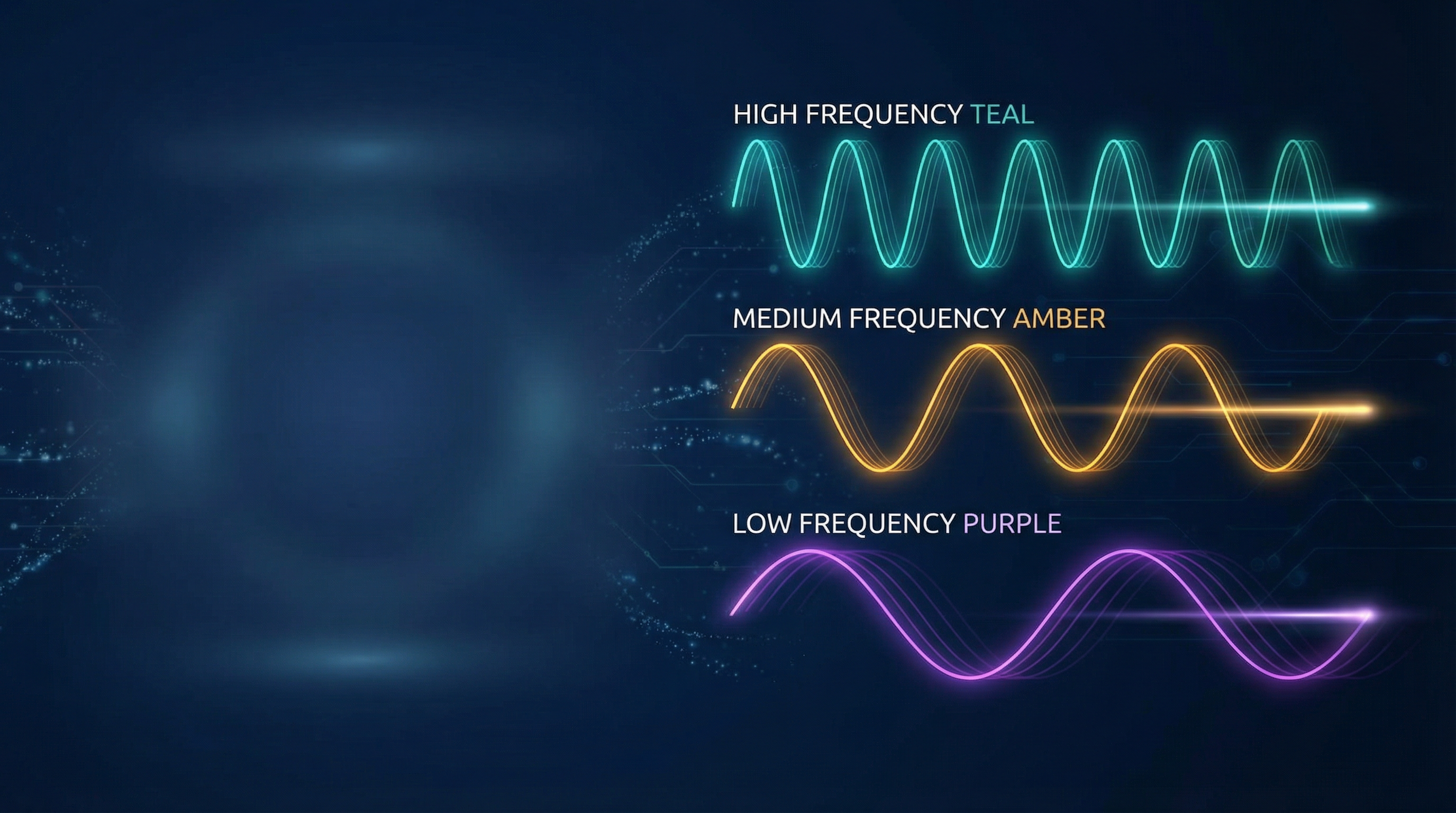
The Three-Way Comparison: At a Glance
| Feature | Alpha (8–13 Hz) | Theta (4–8 Hz) | Gamma (30–100 Hz) |
|---|---|---|---|
| Primary state | Relaxed, unfocused alertness | Deep meditation, hypnagogic, creative flow | High-intensity cognitive binding, peak insight |
| Best for | Stress reduction, creative warm-up, pre-sleep wind-down | Learning, memory encoding, creativity, neuroplasticity | Complex problem integration, peak performance moments |
| BDNF effect | Mild | Strong (direct TrkB activation) | Moderate (via BDNF-NGF co-activation in expert practitioners) |
| Entrain-ability | Easy — accessible to beginners | Moderate — requires relaxed, focused state to enter | Difficult — requires neurological foundation; harder to entrain directly |
| Accessibility for beginners | High | Medium | Low |
| Associated activities | Eyes-closed rest, light meditation, day-dreaming | Deep meditation, REM sleep, hypnagogic states | Expert meditation insight, peak flow, active learning integration |
| Cortisol effect | Mild reduction | Significant reduction | Neutral to mild increase (activating) |
| Research base | Strong | Very strong | Growing, mostly expert-practitioner studies |
Is a Foggy Brain Holding You Back?
Download the free Brain Fog Fix Guide and discover the 12-minute audio technique that thousands use to restore mental clarity — no supplements, no meditation required.
Get the Free Guide →Alpha Waves (8–13 Hz): The Relaxed Alertness Band
Alpha waves are the brain's idle mode — dominant during eyes-closed rest, relaxed wakefulness, and light meditation. EEG studies consistently show alpha as the primary brainwave during daydreaming, creative warm-up, and the transition between active tasks.
What Alpha Actually Does for Cognition
Alpha's cognitive role is primarily inhibitory rather than facilitating: it suppresses sensory processing and reduces "neural noise," creating a quieter internal environment. This is why alpha states feel peaceful and why alpha-dominant creative workers often describe their best ideas emerging during walks, showers, or other low-demand activities.
Alpha also acts as a bridge state — between the high-beta anxiety of stress and the deep theta of meditation. It's the first frequency the brain reaches when it begins to relax from beta overactivity, and it's correspondingly the first effect that binaural beats produce in most beginners.
Alpha Limitations
Alpha is relatively easy to enter (most people achieve it within 5–10 minutes of relaxed eyes-closed rest) but produces more modest cognitive improvements than theta. BDNF effects are mild; LTP induction is minimal; neuroplasticity changes are slow. Alpha is a preparation state — valuable for transitioning into theta, and useful for stress reduction, but not the frequency you want to target as your primary cognitive biohack.
Theta Waves (4–8 Hz): The Biohacker's Priority Frequency
Theta is the frequency that deserves the most attention from any biohacker serious about cognitive performance. It's present during the deepest non-REM sleep transition, during the most productive creative states, during expert meditation, and — critically — during the hippocampal theta rhythm that governs memory encoding and retrieval.
What Theta Does That Alpha and Gamma Cannot
Theta's unique position in the biohacking landscape comes from a convergence of several mechanisms:
- Long-term potentiation (LTP): Hippocampal theta is the oscillatory context in which LTP is most readily induced. Learning in theta states produces more durable, more robust synaptic changes than learning in alpha or beta.
- BDNF via TrkB: Theta oscillations directly activate BDNF's primary receptor (TrkB) in hippocampal neurons — a mechanism that alpha and gamma do not share in the same way.
- Cortisol suppression: Sustained theta is neurologically incompatible with high cortisol. Even 12 minutes of theta reduces salivary cortisol measurably. This is one of the most practically significant effects for knowledge workers operating under chronic stress.
- DMN quieting: Theta states suppress default mode network activity — reducing mind-wandering and the self-referential rumination that impairs focused work.
Theta Accessibility
Theta is moderately accessible via brainwave entrainment — most people begin experiencing it within 8–15 minutes of a well-designed binaural beats session at 5–7 Hz. It requires a quiet environment, comfortable position, and quality headphones. Unlike gamma, it doesn't require extensive neurological development to access.
The research on theta waves specifically is covered in depth in our brainwave science guide — including the specific studies on theta and memory, learning, and creativity.
Gamma Waves (30–100 Hz): The High-Performance Ceiling
Gamma waves represent the highest-frequency brainwave category, associated in EEG studies with high-level cognitive integration — the "binding" of information from different brain regions into unified conscious experience. They're also the frequency associated with insight states: the sudden integration of disparate information that produces the "aha!" moment.
What Makes Gamma Special
The most compelling gamma research comes from the studies of expert meditators mentioned in the meditation EEG article. Lutz et al.'s 2004 PNAS study found extraordinary high-amplitude gamma synchrony in experienced Tibetan Buddhist monks — amplitudes and coherence 25–30 times higher than any non-meditating control.
These extreme gamma states are associated with the subjective experience of profound insight, compassion, and what practitioners describe as "non-dual awareness." From a purely cognitive standpoint, gamma represents the brain at its maximum information-processing capacity.
Gamma's Accessibility Problem
Here's the honest challenge with gamma: it's genuinely difficult to access deliberately. Unlike alpha (which emerges naturally with relaxation) and theta (which can be reliably entrained with binaural beats), gamma at the intensities documented in expert meditators appears to require years of meditative training as a neurological prerequisite.
Consumer binaural beats products targeting gamma frequencies do produce some entrainment response — measurable EEG shifts toward higher frequency — but the amplitude and coherence achieved is a fraction of what expert practitioners display. Gamma entrainment for beginners is more like a mild beta boost than genuine gamma-state access.
Which Should You Target First? The Biohacker's Decision Tree
The answer is straightforward once you understand the relationship between these three states:
- Alpha first, if you're starting from high-beta stress. If you're chronically anxious, overwhelmed, and spend most of your day in reactive mode, alpha entrainment is the appropriate entry point. Use it to decompress, stabilize, and build the neurological foundation for deeper states.
- Theta next, as your primary daily practice. Once you're not operating from a place of chronic stress overload, theta is the priority. It produces the most significant cognitive benefits (LTP, BDNF, cortisol reduction, DMN quieting), is reliably accessible via entrainment, and builds the neurological foundation on which gamma states eventually emerge.
- Gamma as an aspirational outcome, not a starting point. Don't chase gamma entrainment products as a beginner. The science of gamma is real and remarkable — but it's a destination that emerges naturally from consistent theta practice, meditation training, and neurological development over months and years.
This is the biohacker's sequence: alpha → theta → gamma. Don't skip ahead. Theta is where 95% of the accessible cognitive benefit lives, and it's where the evidence base is strongest and most directly applicable to everyday cognitive performance.
For the complete picture of all five brainwave types (including delta and beta), the brainwave science hub has comprehensive coverage of every frequency band.
Start Where the Evidence Is Strongest: Theta
The Genius Song targets the theta frequency range (4–8 Hz) — the brainwave band with the strongest research base for cognitive enhancement and the most accessible entry point for brainwave entrainment. If you're going to start anywhere in the brainwave biohacking space, this is the right starting point.
Get The Genius Song — $39 One-Time →90-day money-back guarantee. Try it risk-free.